Love TarotGently explore your relationship questions, where the connection is heading, and the person on your mind. 🔥 33K+ testedStart Quiz

Vertex in Astrology: What It Means in Your Birth Chart

Published on October 30, 2026 by Sally

Opening Note

The Vertex is a sensitive point in your birth chart, calculated from your birth time, location, and the geometry of the sky—not a physical planet. In some Western astrology traditions, it's linked with significant encounters and turning points, but it doesn't mean love or fate is fixed.

Vertex in Astrology: What It Means in Your Birth Chart
Essay 01

What Is the Vertex in Astrology?

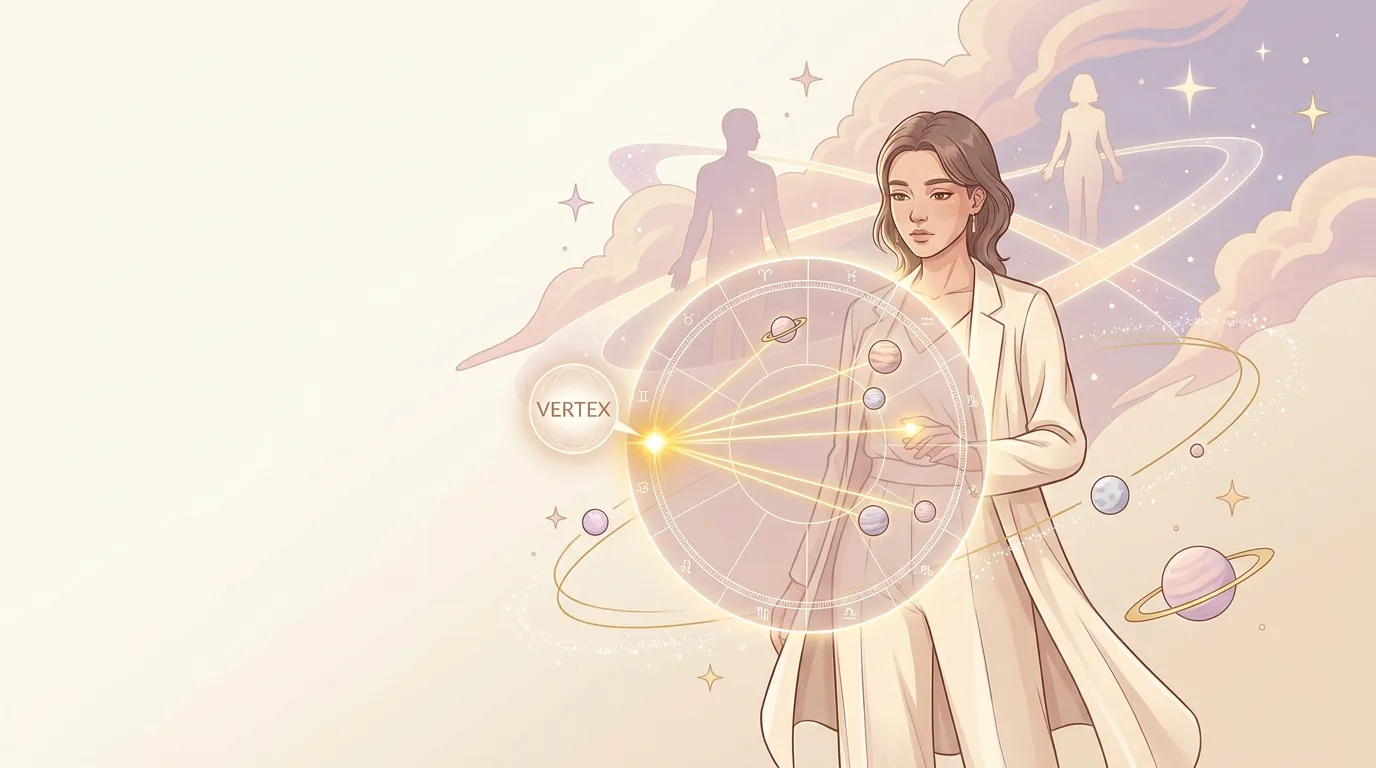
The Vertex is a calculated point where the ecliptic meets the prime vertical in the western half of a birth chart. It is not a planet, so it doesn't describe a constant drive or trait in the way astrologers may interpret planetary placements. Its opposite point, the Anti-Vertex, sits directly across the chart, 180 degrees away; astrologers may read the pair together, but they are not interchangeable with the Descendant or North Node. Some Western astrologers associate Vertex contacts with encounters that feel unusually significant—a colleague who changes your plans, for instance, or a relationship that prompts a new choice. Other traditions give it little emphasis, and there is no single standard for interpreting it.

Essay 02

How to Find Your Vertex in a Birth Chart

To find your Vertex, use a birth chart calculator that includes this point, and enter your exact birth date, birth time, and birthplace. The time matters: the Vertex is sensitive to the chart's calculation conditions, so even an approximate time can shift its position and house. After generating the chart, look for “Vertex” or “Vx” in the chart wheel or placement list. Some calculators hide it by default, so check advanced settings or enable additional points. If your birth time is unknown or uncertain, treat any Vertex sign or house result as provisional rather than a definite reading. A calculator can locate the point; interpreting it still depends on the full chart.

Essay 03

Vertex in the 12 Zodiac Signs

Sign interpretations vary across astrology traditions; treat these as themes, not fixed predictions. Aries: Encounters invite bold beginnings. You may act before certainty arrives. Taurus: Meetings test security. You open slowly, valuing consistency. Gemini: Conversation sparks connection. Curiosity helps you adapt. Cancer: Encounters stir emotional memory. You seek safety and closeness. Leo: Recognition draws people together. You respond with warmth and visibility. Virgo: Shared tasks create meaningful contact. You notice details and offer help. Libra: Partnership themes come forward. You seek balance and mutual regard. Scorpio: Intensity invites deeper trust. You may guard yourself before opening. Sagittarius: New perspectives spark connection. You follow curiosity beyond routine. Capricorn: Responsibility shapes important meetings. You respond by taking things seriously. Aquarius: Unusual connections challenge expectations. You need room to be yourself. Pisces: Compassion or imagination draws people close. You may soften your boundaries.

Essay 04

Vertex in the Houses

Vertex house placement adds context: it points to life areas where encounters may feel consequential, not to a guaranteed outcome. It is commonly found in the western half of the chart, though its exact house depends on accurate birth time, location, and chart calculation. In the 5th House, a meeting may stir romance, play, or creative confidence; the 6th can make routine work or practical cooperation unexpectedly significant. The 7th brings focus to partnership and negotiation, while the 8th can highlight intimacy, shared resources, or the courage to trust. A colleague whose steady help changes your daily rhythm may feel pivotal without becoming a romantic partner. The house describes a setting for reflection; the full chart clarifies what unfolds.

Essay 05

Vertex Aspects to the Sun, Moon, Venus, and Saturn

Vertex aspects suggest which personal themes may become vivid around encounters; they do not, by themselves, predict what another person will do. A contact with the Sun can make a meeting challenge or clarify someone's sense of identity, perhaps prompting a career or life-direction choice. Moon contacts may stir immediate emotional familiarity or expose different needs for security. Venus links can sharpen attraction, affection, or questions of shared values, while Saturn contacts may bring responsibility, boundaries, timing, or a commitment that must be tested in ordinary life. For example, chemistry may feel immediate, but Saturn's presence can make the relationship's practical demands just as noticeable. Interpret the aspect's type, orb, and whole chart together.

Essay 06

The Vertex in Synastry

In synastry, when one person's planet makes a close aspect—especially a conjunction—to another person's Vertex, astrologers may read the contact as an encounter that stands out in the Vertex person's story. The first conversation can feel oddly well-timed, or a coworker's idea may redirect a project and later change how both people see their options. That intensity describes a subjective impression, not proof of a soulmate bond or a promise that the relationship will last. The planet person may embody a theme the Vertex person is meeting, while the rest of both charts shows how it develops. Consider mutual aspects, context, and behavior over time; a compelling first impression is only one part of compatibility.

Essay 07

Vertex vs. the North Node and Descendant

These three chart points answer different questions: the Vertex is sometimes read as a catalyst for significant encounters, the North Node as a direction for growth, and the Descendant as a description of partnership themes. Imagine meeting a colleague whose invitation leads to a major career choice. A Vertex interpretation might focus on the encounter's timing and impact; the North Node might frame the skills or perspective you are developing; the Descendant might illuminate how you approach one-to-one collaboration. They can relate to the same story without meaning the same thing. The Vertex does not replace either point, and none guarantees a particular relationship or life event; their usefulness depends on the full chart and the astrologer's tradition.

Essay 08

How to Interpret the Vertex in Your Birth Chart

Read the Vertex through its sign, house, close aspects, and the wider birth chart—not as a stand-alone prediction. For example, a Virgo Vertex in the 7th House might describe consequential partnerships that bring attention to practical care, shared routines, or the balance between helping and over-functioning. A close Saturn aspect could add themes of responsibility or boundaries, while other chart placements would change the picture. The real-life question might be whether a new collaborator's steady approach changes how you define commitment, not whether the chart promises a lasting bond. Because the Vertex is sensitive to birth time and place, an uncertain birth time cannot support a confident house-based reading. Treat interpretations as possibilities, not fate.

“Meaningful encounters can shape your path without deciding it for you.”