Love TarotGently explore your relationship questions, where the connection is heading, and the person on your mind. 🔥 33K+ testedStart Quiz

Synastry Chart Calculator: How to Compare and Read Two Birth Charts

Published on October 19, 2026 by Sally

Opening Note

A synastry chart overlays two birth charts to explore how their planets and houses interact. It looks beyond zodiac-sign matches to emotional connection, attraction, communication, and patterns that may shape a relationship over time.

Synastry Chart Calculator: How to Compare and Read Two Birth Charts
Essay 01

What Is a Synastry Chart?

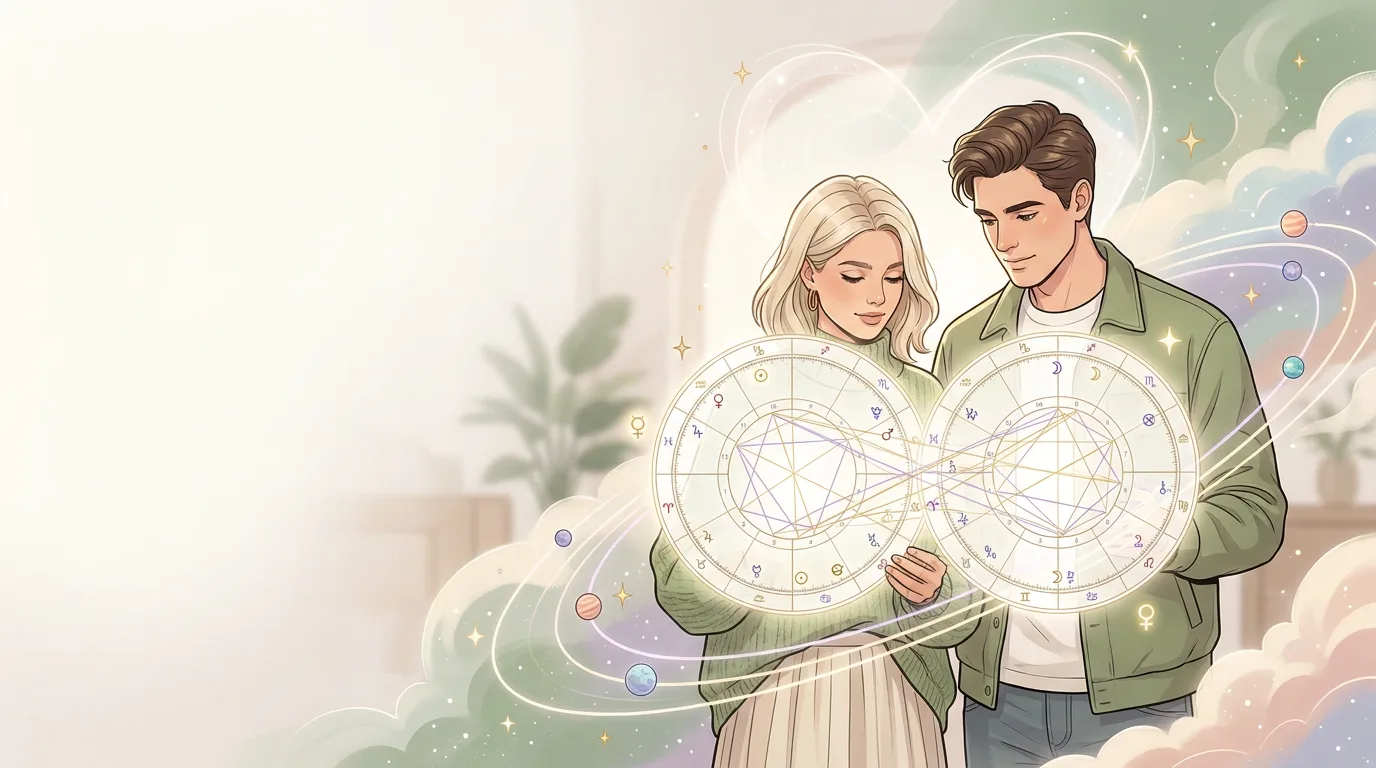
A synastry chart compares two people's birth charts without blending them into one. A Birth Chart, or natal chart, describes one person's planetary placements at birth; synastry places two natal charts side by side to show where their planets interact. A Composite Chart is different: it combines the charts mathematically to create a single chart often read as a symbol of the relationship itself. Imagine checking why one person's directness feels reassuring to a date but abrupt to someone else. Synastry offers a symbolic way to explore that difference by looking at specific planetary contacts, not just Sun signs. It can highlight themes in emotional responses, attraction, conversation, and commitment, but it does not determine whether two people will succeed together. Think of it as a map for reflection, not a verdict on the relationship.

Essay 02

How to Use a Synastry Chart Calculator

To create a comparison, enter each person's birth date, birth time, and birthplace into a Synastry Chart Calculator, keeping the details matched to the correct person. Check that the locations and times are accurate, then generate the chart showing both natal charts together. If the calculator asks you to identify the chart type or chart order, choose synastry and note whose placements appear in each ring; layouts vary. Birth time matters because it affects the Ascendant, house cusps, and the placement of planets by house. If one person does not know their birth time, you can still compare some planetary positions and aspects, but house overlays and angle contacts may be unreliable. Avoid treating missing time data as a small detail: it limits what the comparison can confidently show.

Essay 03

How to Read a Synastry Chart Wheel

Start by identifying whose chart is in the inner ring and whose is in the outer ring; the labels or chart key should tell you, since the arrangement can vary. The symbols mark each person's planets and points, while the signs show how those placements are expressed. Lines between the rings indicate aspects—planet-to-planet relationships—which are different from house overlays. For an overlay, see which house in one person's chart contains a planet from the other person. For example, one person's Venus falling in the other's fifth house is a house placement, not an aspect. Keep track of whose planet and whose house you are reading: the planet describes what one person brings, while the receiving house suggests an area of life where the other may experience it. This distinction keeps the chart from becoming a tangle of symbols.

Essay 04

Sun, Moon, Venus, and Mars in Synastry

Sun, Moon, Venus, and Mars describe different parts of how two people meet; no single one stands in for overall compatibility. The Sun points to identity and the qualities each person naturally expresses, so a Sun connection may feel like admiration—or competing preferences about how to spend a Saturday. The Moon speaks to emotional habits and comfort: one person may want to talk through a disappointment immediately while the other needs quiet first. Venus shows affection, pleasure, and romantic taste, visible in how partners give compliments or plan a date. Mars adds desire, initiative, and conflict style; its contact can bring chemistry, but also friction over who chooses, moves faster, or takes the lead. Read these planets together: easy Venus attraction does not automatically mean Moon-level ease, and a lively Mars connection does not guarantee calm everyday rhythms.

Essay 05

How to Read Synastry Aspects

Synastry aspects describe the angles between planets in two charts; they are not the same as house overlays. A conjunction brings two planetary themes close together, intensifying their interaction, while a trine often suggests an ease that can feel natural. A sextile can offer cooperation that grows when both people engage with it. Squares may create productive tension or recurring irritation: for example, a Moon-Mercury square can leave one person feeling unheard when the other responds to emotion with explanations. An opposition can highlight differences that attract and require negotiation; Venus opposite Mars, for instance, may spark desire while partners differ on pace or expression. These aspects are not automatic verdicts. Notice which planets are involved, how the pattern shows up in ordinary moments, and whether other chart factors echo or soften it.

Essay 06

What House Overlays Reveal About Romance

House overlays show where one person's planets fall in the other person's chart, highlighting areas of life the connection may bring into focus. They describe a different layer from aspects, which show how planets interact. A partner's planets in your 5th House can make dating feel playful and expressive: you may look forward to flirting, shared hobbies, or planning a spontaneous night out. The 7th House is associated with partnership, so an overlay there can make commitment and the idea of “us” feel especially present in everyday choices. The 8th House brings more intensity around trust, vulnerability, intimacy, or shared resources; conversations about privacy or money may feel unusually charged. None guarantees a particular outcome. Because house placements rely on accurate birth times, treat them cautiously when either time is unknown.

Essay 07

Saturn, Jupiter, and Mercury in Synastry

Saturn, Jupiter, and Mercury reveal how a connection handles commitment, growth, and everyday communication—areas that matter after initial attraction. Saturn can bring reliability and a willingness to work through difficulty, but one person may also feel judged or pressured when the other insists on a plan. Jupiter often adds generosity and enthusiasm: a couple might encourage each other to travel, study, or take a bigger career step, though unchecked optimism can leave practical responsibilities to one partner. Mercury describes how people exchange ideas and resolve misunderstandings. Easy Mercury contacts may make planning feel natural; tense ones can turn a simple text into a debate over tone or intent. These planets offer useful context, not a verdict: strong chemistry may coexist with mismatched expectations about responsibility, future plans, or how conflict gets repaired.

Essay 08

How to Put the Whole Synastry Chart Together

Read the chart as a pattern, not a scorecard. If one person's Venus connects smoothly with the other's Mars, attraction may come easily, but that alone says little about how they handle shared expenses or a stressful week. Look across the planets, aspects, and house overlays, then ask how those themes show up in real life: Do they feel emotionally understood, communicate through disagreement, and follow through on commitments? A supportive connection in one area can balance friction elsewhere, while several tense contacts may point to recurring pressure rather than certain failure. Compare both complete Birth Charts, too; each person brings their own needs and habits into the relationship. Synastry is a symbolic framework, not a scientific prediction of success. A fuller reading considers planets, aspects, house overlays, and both complete birth charts together.

“Compatibility is more than a Sun-sign match.”