Love TarotGently explore your relationship questions, where the connection is heading, and the person on your mind. 🔥 33K+ testedStart Quiz

Synastry Aspects Explained: Conjunctions, Squares & Oppositions

Published on October 21, 2026 by Sally

Opening Note

Synastry aspects are the angles formed between planets in two people's birth charts, revealing how they may interact in attraction, emotion, communication, and conflict. Harmonious aspects don't guarantee happiness, and tense ones don't mean a breakup is inevitable.

Synastry Aspects Explained: Conjunctions, Squares & Oppositions
Essay 01

What Are Synastry Aspects?

Synastry aspects are the angles between planets in two people's birth charts; they describe how their energies may interact. They're different from natal aspects, which show relationships between planets within one person's chart, and from house overlays, which show where one person's planets land in the other's chart. For example, a natal Moon–Mercury aspect may describe how you process your own feelings and words, while a partner's Moon making an aspect to your Mercury can describe how your emotional reactions meet their communication style. House overlays add another layer: a partner's planet in your seventh house may emphasize partnership, but it doesn't tell you by itself how your planets interact.

Essay 02

How to Read Synastry Aspects

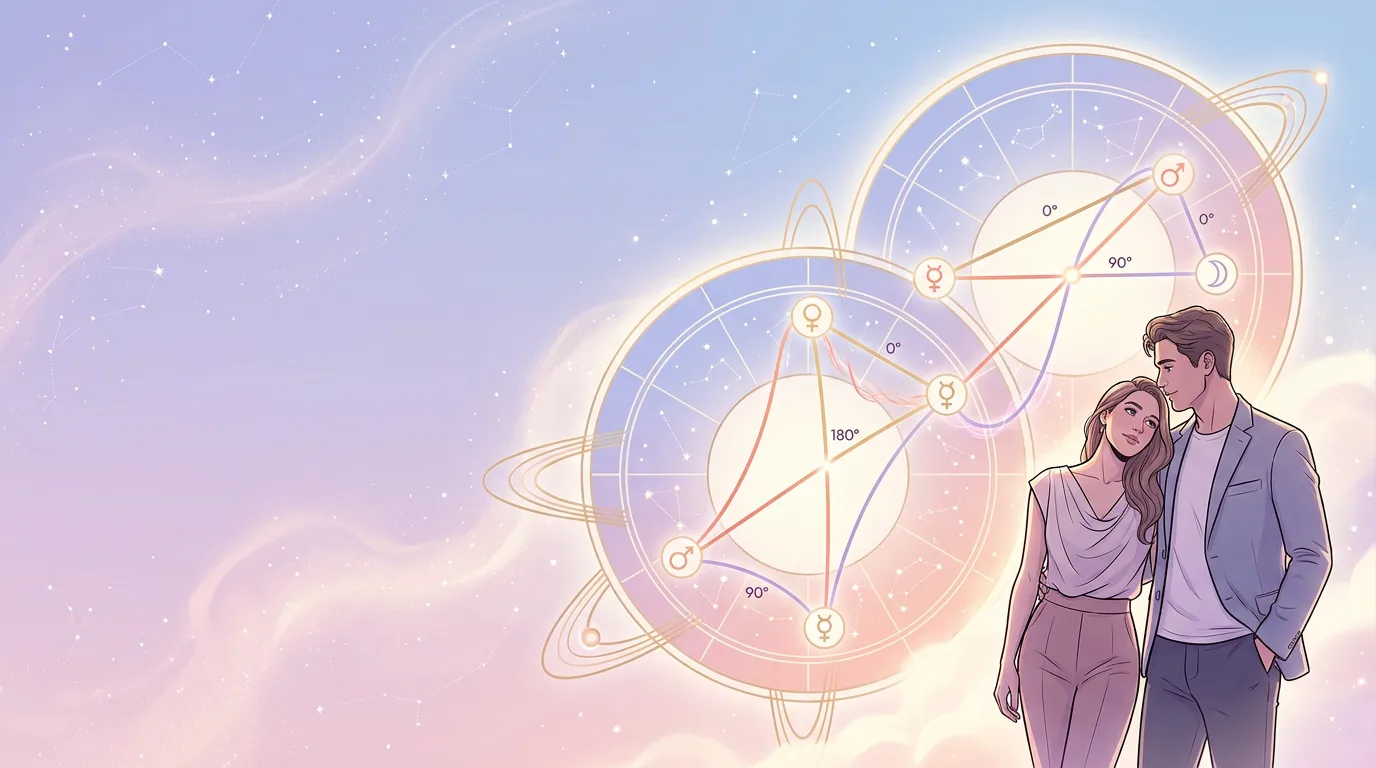
To read a synastry aspect, identify the two planets, the angle between them, and how close that angle is. Cross-chart aspects connect a planet in one person's chart to a planet in the other's—not two planets belonging to the same person. A chart comparison or synastry report usually marks these connections; check which chart each planet belongs to before interpreting them. The orb is the distance from an exact angle, and astrologers differ on how wide an orb they accept, so there is no single universal cutoff. In practice, a close Mercury–Moon aspect might show up when one person's quick text feels reassuring to the other—or unexpectedly blunt.

Essay 03

Conjunction in Synastry: 0°

A conjunction brings two planets together at 0°, blending and intensifying their themes; that closeness can feel magnetic, but it isn't automatically easy. With a Sun–Moon conjunction, one person's sense of identity may strongly engage the other's emotional needs: a date can feel immediately familiar, while decisions about how much time to spend together may reveal different needs. A Venus–Mars conjunction can add noticeable romantic or physical chemistry, yet attraction alone doesn't settle questions about trust, timing, or shared priorities. These planets may amplify each other in ways that feel affirming or overwhelming. Strong chemistry doesn't always mean strong compatibility, and the rest of both charts matters.

Essay 04

Trine and Sextile in Synastry: 120° and 60°

Trines and sextiles can make connection feel easier, but ease is not the same as commitment. A trine forms at 120° and often supports natural flow; a sextile forms at 60° and can point to cooperation that grows when both people engage. For example, one person may feel understood during a relaxed first date, or find it easy to share affection without scripting every gesture. With a sextile, the opening may be quieter: one person suggests a plan, and the other responds warmly, but neither follows through unless they choose to. These aspects can soften daily interactions, yet a trine alone cannot ensure reliability or shared long-term goals.

Essay 05

Square in Synastry: 90°

A square forms when planets are 90° apart, creating pressure where two styles don't easily fit. In a Moon–Mercury square, one person may need comfort first, while the other answers with explanations or solutions. After a tense day, “I just wanted you to listen” can meet “I was trying to help,” leaving both feeling misunderstood. The friction can make emotional conversations tiring, especially over text, where tone is easy to misread. It may also reveal what each person needs to learn about listening and speaking plainly. Growth is possible, not automatic: repeated defensiveness can harden the pattern, while curiosity can make disagreement more productive.

Essay 06

Opposition in Synastry: 180°

An opposition forms at 180° and can create a vivid pull between contrasting needs. In a Venus–Mars opposition, one person's way of showing affection may excite the other, while their pace or style also feels frustrating. A flirtatious exchange can turn into a debate about who initiates, how direct to be, or whether a bold advance feels welcome. The contrast may feel complementary—each brings what the other lacks—but attraction can disguise incompatible expectations about intimacy. Strong chemistry doesn't always mean strong compatibility. This aspect can invite negotiation and mutual adjustment, yet it guarantees neither. What matters is whether both can respect differences beyond charged moments, including ordinary choices about time, attention, and commitment.

Essay 07

Key Planetary Pairings to Watch in Love Synastry

Some planetary pairs reveal everyday relationship needs more clearly than any single headline aspect. A Moon–Venus link can make affection feel soothing: one person offers a kind check-in, and the other feels remembered. Yet comfort doesn't mean both want the same pace or commitment. Venus–Mars speaks to desire and romantic initiative, while its aspect shows whether that spark flows easily or comes with tension. Mercury–Mercury colors how partners trade ideas, handle silence, and repair a misunderstanding. Moon–Saturn can support loyalty and steadiness, but reassurance may feel scarce if care is expressed mainly through duty. Consider the planets together with their aspect and the rest of each chart: one pairing is a clue, not a verdict.

Essay 08

How to Read the Whole Synastry Chart

Read a synastry chart as a pattern, not a scorecard. Several aspects may repeat a theme: for example, easy Mercury contacts can help a couple talk things through, while tense Moon contacts may make emotional timing harder. House overlays add context by showing where a partner's planets tend to draw attention, and each birth chart describes that person's own needs and habits. Imagine a date that feels magnetic, followed by a confusing exchange about when to meet again. Strong chemistry doesn't always mean strong compatibility; one striking Venus–Mars aspect can't answer how two people handle care, conflict, or commitment. Weigh the whole pattern, including both ease and friction, before drawing conclusions.

“Strong chemistry doesn't always mean strong compatibility.”