Live Tarot ReadingTalk one-on-one with a professional tarot reader and find clarity around relationships, choices, and your direction in life. 🔥 71K+ testedStart Quiz

Planets in Astrology: What Each Planet Means in Your Birth Chart

Published on October 15, 2026 by Sally

Opening Note

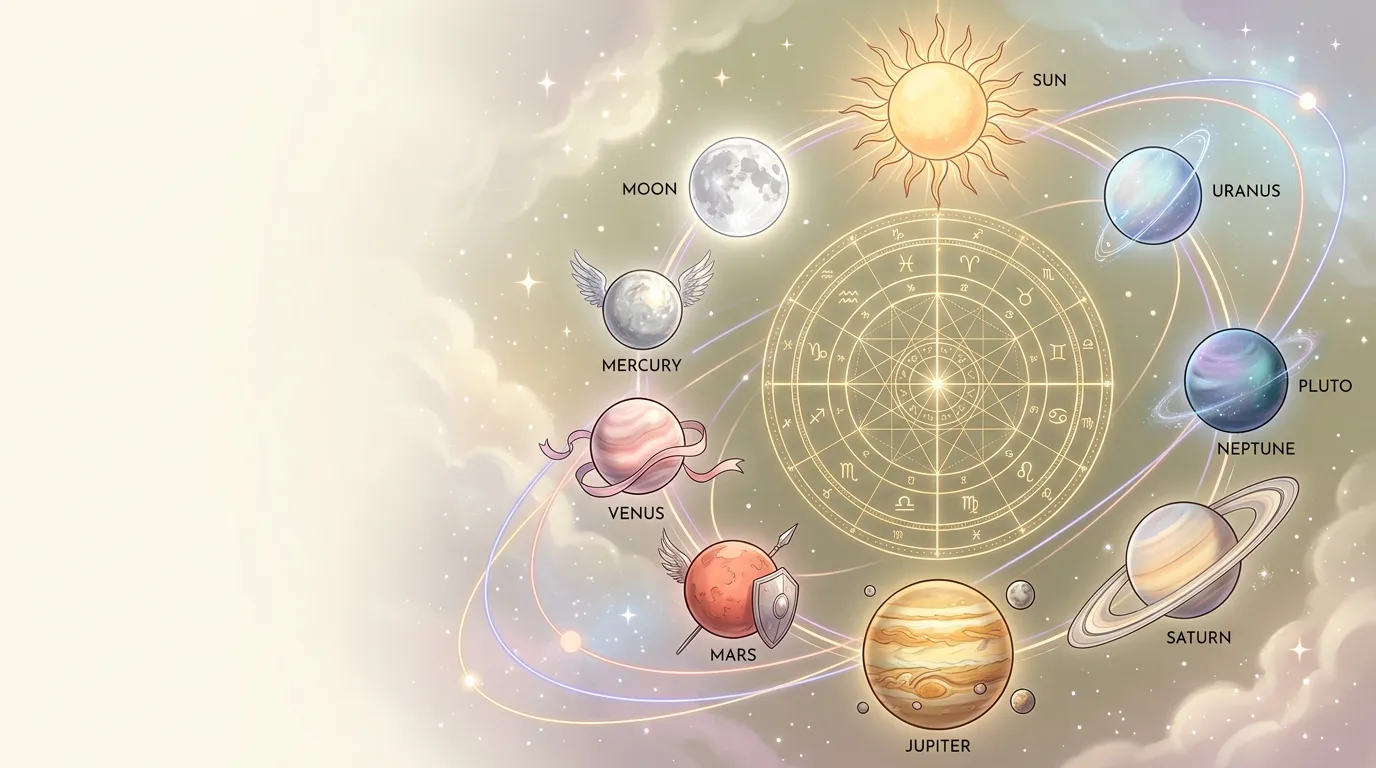
In Western astrology, planets describe psychological functions, life themes, and patterns of action in your birth chart. The Sun and Moon are included in astrology's planetary system, even though they are not astronomical planets. Planets show what energy is at work, signs how it is expressed, houses where it appears, and aspects how those energies interact.

Planets in Astrology: What Each Planet Means in Your Birth Chart
Essay 01

What Planets Mean in a Birth Chart

Planets describe different functions and themes in your life, from how you think to what makes you feel secure or motivated. Personal planets—Sun, Moon, Mercury, Venus, and Mars—often feel closest to everyday choices and relationships. Social planets, Jupiter and Saturn, connect personal development with wider responsibilities and opportunities. Outer planets—Uranus, Neptune, and Pluto—reflect broader generational themes, though their house placements and aspects can make them especially relevant to an individual. No planet works alone: its sign, house, and connections with other planets shape how its energy shows up.

Essay 02

Sun: Identity, Self-Expression, and Purpose

The Sun describes core identity, self-expression, and the motivation that helps you feel purposeful. It is less a fixed personality label than a developing center of direction. At work, it can show what kind of contribution feels meaningful; in relationships, how you want to be seen and appreciated. A Sun in Aries may seek direct, self-starting expression, while the Sun in the 10th house can make public goals and responsibility central to identity. Neither placement guarantees ambition: the whole chart shapes how solar drive emerges. The Sun also points to qualities you grow into over time.

Essay 03

Moon: Emotions, Security, and Instinct

The Moon describes emotional needs, instinctive reactions, and what helps you feel safe. Its influence often shows up before you have time to explain a feeling: after a demanding day, one person wants quiet at home, while another seeks a familiar conversation. In close relationships, this can shape how someone responds to stress and receives comfort, not simply how affectionate they are. A Moon in Cancer in the 4th House may make home, family memories, and private routines especially important sources of security. Other signs and houses can express those needs differently; the Moon is a pattern, not a verdict.

Essay 04

Mercury: Thinking, Communication, and Learning

Mercury describes how you think, communicate, and learn, including the questions you ask and the details you notice. In daily life, it may shape whether you prefer a quick verbal brainstorm, careful written notes, or time to compare information before deciding. During a disagreement, Mercury's style can influence whether someone explains their reasoning, asks clarifying questions, or needs a pause to organize thoughts. Mercury in Gemini in the 3rd House may emphasize curiosity, frequent conversation, and learning through exchange. A different sign or house changes the style and setting; Mercury does not determine intelligence or guarantee one way of speaking.

Essay 05

Venus: Love, Attraction, and Values

Venus describes what you value, how you give and receive affection, what draws you in, and the beauty or pleasure you seek. In a relationship, it can show up in small choices that make closeness feel real: planning a thoughtful date, sharing favorite music, or wanting time to enjoy things at an unhurried pace. Venus also colors taste and priorities, including what feels worth spending time or money on. Venus in Taurus, for example, may seek steady affection and sensory comfort, while Venus in Gemini may prize playful conversation and variety. Neither placement guarantees a particular romantic style; the whole chart adds context.

Essay 06

Mars: Action, Desire, and Conflict

Mars describes how you pursue what you want, assert yourself, handle competition, and respond when frustrated. At work, it may shape whether you volunteer for a difficult task, push directly for a decision, or wait for the right opening; in close relationships, it can influence how desire and disagreement surface. Mars is not simply anger—it also relates to initiative and stamina. Mars in Aries, for example, may favor quick, direct action, while Mars in Cancer may act protectively and respond more to emotional cues. These are tendencies, not fixed outcomes; the sign, house, and aspects refine how Mars operates.

Essay 07

Jupiter: Growth, Opportunity, and Beliefs

Jupiter represents growth, opportunity, belief, and the areas where you are inclined to think bigger. At work, it may show up as volunteering for a stretch project or feeling energized by a mentor's confidence; in personal life, it can shape the principles you want to pass on. Jupiter in Virgo, for example, may seek growth through refining skills and making useful systems, while Jupiter in the 9th house can emphasize travel, higher education, or encounters that broaden perspective. Neither placement guarantees luck; each suggests where confidence and expansion may develop, sometimes alongside overpromising or overlooking limits.

Essay 08

Saturn: Responsibility, Discipline, and Maturity

Saturn points to responsibility, discipline, limits, and the slower work of becoming more capable over time. It can be felt when a new role comes with duties no one else notices, or when a family commitment requires steady follow-through rather than dramatic gestures. Saturn in Cancer, for example, may bring a serious approach to emotional security and caregiving, while Saturn in the 10th house can make career obligations and public reputation especially weighty. These placements do not mean a person is destined for hardship; they can describe areas where caution, practice, and patience gradually build confidence and durable skill.

Essay 09

Uranus: Independence, Innovation, and Change

Uranus describes the urge to question conventions, experiment, and make room for greater independence. Because it moves slowly, its sign often reflects a generational attitude toward change; its house shows where that theme may feel more personal. Uranus in the 10th house, for example, can coincide with an unconventional career path or a desire to redefine professional success, while Uranus in the 4th may bring a less traditional approach to home and family. Disruption is not guaranteed: the placement can also show where originality matters more than following an inherited script.

Essay 10

Neptune: Imagination, Ideals, and Boundaries

Neptune describes imagination, ideals, sensitivity, and the places where boundaries can feel less clear. Its sign is shared by many people born across the same period, so it is not a private personality stamp; its house points to a life area where longing or inspiration may be especially vivid. With Neptune in the 7th house, someone may be deeply moved by a partner's vulnerability yet assume they share the same expectations before discussing them. The same placement can support compassion and artistic connection, while inviting a distinction between genuine closeness and an idealized picture.

Essay 11

Pluto: Power, Deep Transformation, and Control

Pluto points to deep transformation, power, and the control issues that surface when change feels unavoidable. Its themes may appear when someone struggles to delegate at work or has to reconsider who holds influence in a family or partnership. Pluto does not make a person controlling; intense situations can instead expose what they fear losing. Pluto in the 10th house, for example, can focus this process on career and public responsibilities, while its sign describes a style shared by a generation, not a private trait. Its expression depends on the whole chart.

Essay 12

How to Interpret Planets Together

To read a planet, combine what it represents with its sign's style, its house's life area, and its aspects' connections to other planets. Venus in Leo in the 5th House, for example, links affection and values (Venus) with a warm, expressive style (Leo) in romance or creative play (the 5th House); aspects can show how that energy interacts with the rest of the chart. No single placement tells the whole story, so exploring your complete birth chart can show how your planetary placements work together.

“Planets show what; signs show how; houses show where; aspects show how energies interact.”