Placidus vs. Whole Sign Houses: Which House System Should You Use?

Published on November 5, 2026 by Sally

Opening Note

Placidus and Whole Sign are two common house systems in Western astrology, and they can place the same planets in different houses. Neither is universally more accurate; each uses a different way of dividing the birth chart.

Placidus vs. Whole Sign Houses: Which House System Should You Use?
Essay 01

What Is a House System in Astrology?

A house system is the method an astrologer uses to divide a birth chart into twelve areas of life. It does not change your zodiac system, signs, or the planets' positions; it changes where house boundaries fall. That is why two charts made from the same birth date, time, and place can assign a planet to different houses. In a reading, that shift changes the life area an astrologer emphasizes: a relationship pattern might be discussed through daily routines in one chart and partnership in another. The chart itself has not become a different prediction. You are looking at the same sky through two different frameworks for organizing its themes.

Essay 02

How Placidus Houses Are Divided

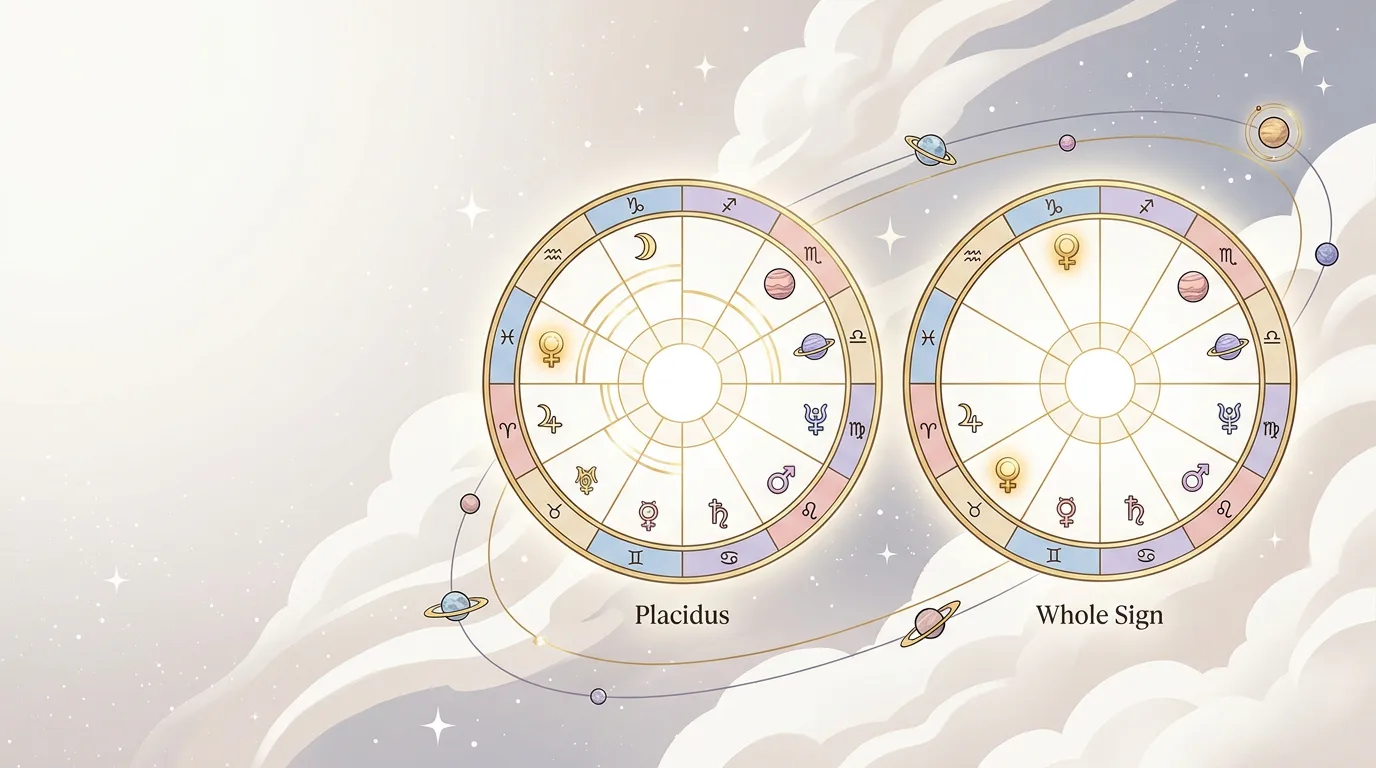
Placidus divides the chart according to the time celestial points take to travel through the sky's visible and invisible halves. It is a quadrant system: the Ascendant, Descendant, Midheaven, and IC anchor the chart, with the intervening spaces divided using those time-based arcs. Because the sky's apparent movement is not uniform relative to every location and chart angle, Placidus houses are usually unequal in size. In a reading, that can give extra emphasis to a life area covered by a particularly wide house, while a narrow house may contain several cusps close together. For someone weighing a career change or family responsibility, the astrologer follows these specific Placidus boundaries when locating the relevant planets.

Essay 03

How Whole Sign Houses Are Divided

Whole Sign Houses assigns one complete zodiac sign to each house. The sign containing the Ascendant becomes the entire first house, and each following sign becomes the next house, with every house measuring 30 degrees. The Ascendant keeps its actual degree within its sign; it does not have to sit at the start of the first house. The Midheaven also retains its calculated position, but it may fall in a house other than the tenth. For example, an astrologer considering partnership or family themes can identify the relevant house by sign order, even when an angle sits elsewhere. This regular layout makes house boundaries straightforward to spot in a birth chart.

Essay 04

Placidus vs. Whole Sign: Key Differences

The main difference is where each system places house boundaries, not which zodiac signs or planetary positions it uses. In Placidus, the Ascendant marks the first-house cusp, and the MC is usually the tenth-house cusp; other cusps can fall at different degrees and house widths vary. In Whole Sign, the Ascendant's sign is the entire first house, while its exact degree remains important in the chart. The MC also keeps its actual position, but it may fall in a house other than the tenth. A planet's sign and degree stay the same even if its house changes. At high latitudes, Placidus may not calculate normally, depending on the location and calculator's algorithm.

Essay 05

Why Can a Planet Fall in Different Houses?

A planet changes houses between systems when it sits near a boundary that the two methods place differently. For example, Venus might be in the sixth house in a Placidus chart but the seventh in Whole Sign. Its sign and degree have not moved: the systems frame its themes differently. In a sixth-house reading, Venus may describe pleasure or connection woven into daily work, routines, or service. In a seventh-house reading, partnership and one-to-one bonds become a stronger focus. This does not mean one chart is wrong or that a relationship outcome is certain. When comparing calculators, check that the birth time, location, zodiac, and planetary placements match before interpreting the different house labels.

Essay 06

How House Systems Shape Love, Career, and Family Readings

House systems can shift the life area emphasized in a reading without changing the planets themselves. If a planet moves into or out of the seventh house, an astrologer may weigh its role in partnership differently; that is a change in emphasis, not proof that love will unfold a particular way. The tenth house also needs care: Whole Sign places one complete sign there, but the MC may land in another house, while Placidus usually uses the MC as the tenth-house cusp. A career reading can therefore consider both the tenth house and the MC. Family themes may likewise be framed through different house placements. Compare the chart's actual placements and context rather than treating one system as a verdict.

Essay 07

Should Beginners Choose Placidus or Whole Sign?

For beginners, the best house system is the one you can use consistently and understand—not the one claimed to be more accurate. Whole Sign can be simpler to map: identify the Ascendant's sign, and each following sign corresponds to the next house. Placidus, common in many modern chart resources, uses unequal houses and encourages attention to cusps and chart angles. Whole Sign has roots in traditional astrology, while both systems are used by contemporary astrologers. If Venus appears in a different house in each system, compare what each framework emphasizes in the relationship story without forcing one interpretation. You can choose a default and still consult the other.

Essay 08

How to Compare House Systems in a Birth Chart Calculator

Use a Birth Chart Calculator to compare the systems with the same birth date, exact time, and location. Select Placidus, note the house placements, then switch only the House System setting to Whole Sign. Check which planets change houses, while remembering that their signs and planetary positions do not change. In Whole Sign, the MC retains its actual degree and may fall outside the 10th house. Read the placements alongside Signs, Planets, and Aspects, then consider how they fit within the complete Birth Chart rather than treating one changed house as a verdict. This side-by-side view helps you see what each system highlights.

“Same birth chart, different house map.”