Romance ReportWho might come closer? Explore your romantic opportunities, changing appeal, and connections worth noticing through BaZi. 🔥 18K+ testedExplore Your Romantic Outlook

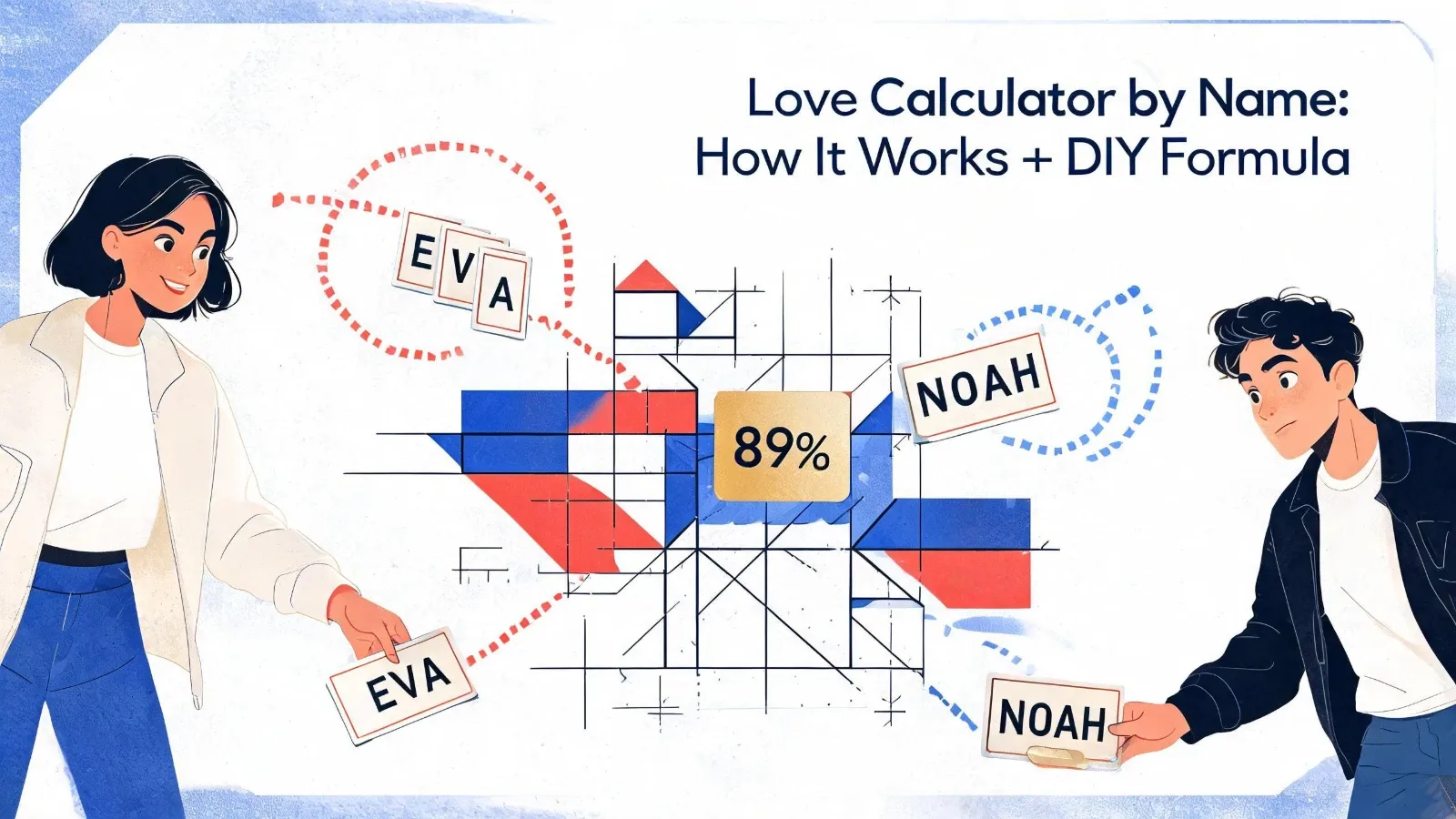
Love Calculator by Name: How It Works + DIY Formula

Published on October 10, 2026 by Fiona

Opening Note

Enter two names, press a button, and a number such as 68% or 92% appears. It can feel strangely meaningful, especially when the names belong to you and someone you cannot stop thinking about. But what is a love calculator by name actually calculating? The short answer is that there is no universal formula. Most tools turn letters into numbers through a repeatable game involving letter counts, numerology, or a computer-generated hash. The result can be entertaining and consistent, but it cannot measure attraction, trust, communication, or the future of a relationship.

Love Calculator by Name: How It Works + DIY Formula
Essay 01

What Does a Love Calculator by Name Measure?

A name-based love calculator works with text, not people. It receives two names, standardizes their spelling, applies a fixed set of numerical rules, and converts the result into a percentage. If the same spellings are entered again, a deterministic calculator should return the same score. Different websites can give the same couple completely different results because they may not use the same rules. For example, one published calculator counts letters from “TRUE LOVE,” while another converts the names into an MD5 hash and maps part of that number onto a chosen percentage range. Both perform real calculations, but neither formula has been scientifically established as a measure of romantic compatibility. Common approaches include: - Counting letters from words such as TRUE LOVE or LOVES - Removing matching letters and playing the FLAMES elimination game - Assigning letters numerical values through name numerology - Comparing shared letters, vowels, initials, or name lengths - Converting the two names into a repeatable computer hash Because the formulas are different, “Which result is correct?” does not have a universal answer. The more useful question is whether the calculator clearly explains the game it is using.

Essay 02

The TRUE LOVE Letter-Counting Method

The following method is easy to calculate without a website. It is one commonly used pen-and-paper version of a love test using names. It produces a two-digit score by counting the letters in TRUE and LOVE. The first digit comes from TRUE; the second digit comes from LOVE. Step 1: Prepare the two names Write both names together and convert them to uppercase. Remove spaces, punctuation, numbers, hyphens, and apostrophes. For example: Valerie + Everett becomes: VALERIEEVERETT Use either first names or full names, but apply the same choice to every pair you compare. A nickname and a legal name contain different letters, so they will usually produce different scores. Step 2: Count the letters in TRUE Count how many times the following letters appear across both names: - T - R - U - E Add the four counts together. If the total has two digits, add those digits repeatedly until only one digit remains. For example, a total of 14 becomes: 1 + 4 = 5 That final digit becomes the first digit of the love score. Step 3: Count the letters in LOVE Repeat the process with: - L - O - V - E Add the counts and reduce the total to one digit when necessary. This becomes the second digit. The letter E appears in both TRUE and LOVE, so it is counted in both parts of the calculation. Step 4: Put the digits together Place the TRUE digit first and the LOVE digit second. If the TRUE digit is 6 and the LOVE digit is 8, the result is: 68% Do not add the two final digits. They are placed beside each other to form the score. Example 1: Valerie and Everett First combine the names: VALERIEEVERETT Count the TRUE letters: - T appears 2 times - R appears 2 times - U appears 0 times - E appears 5 times 2 + 2 + 0 + 5 = 9 The TRUE digit is 9. Now count the LOVE letters: - L appears 1 time - O appears 0 times - V appears 2 times - E appears 5 times 1 + 0 + 2 + 5 = 8 The LOVE digit is 8. Place the digits together: 98% This is a high result because these two spellings contain many of the letters used in TRUE LOVE. It does not mean Valerie and Everett are guaranteed to have an ideal relationship; it means their names happen to interact strongly with this particular letter-counting rule. Example 2: Evelyn and Theodore Combine the names: EVELYNTHEODORE Count the TRUE letters: - T appears 1 time - R appears 1 time - U appears 0 times - E appears 4 times 1 + 1 + 0 + 4 = 6 The TRUE digit is 6. Count the LOVE letters: - L appears 1 time - O appears 2 times - V appears 1 time - E appears 4 times 1 + 2 + 1 + 4 = 8 The LOVE digit is 8. The final result is: 68% This score sits in the middle because the two names contain several matching target letters without producing exceptionally high totals. Example 3: Olivia and Noah Combine the names: OLIVIANOAH Count the TRUE letters: - T appears 0 times - R appears 0 times - U appears 0 times - E appears 0 times The TRUE digit is 0. Count the LOVE letters: - L appears 1 time - O appears 2 times - V appears 1 time - E appears 0 times 1 + 2 + 1 + 0 = 4 The LOVE digit is 4. The final result is: 04% This low result exposes the most important limitation of a name compatibility test: the algorithm rewards certain spellings. Olivia and Noah receive a low number simply because their names contain none of the letters in TRUE, not because the calculator knows anything about them. How to Interpret Your Score These ranges can make the result more fun to share, but they describe how two spellings behave inside the game—not the quality of a real relationship. - 00–29%: Few target letters The two names contain relatively few letters from TRUE LOVE. - 30–59%: Mixed letter pattern The names create a moderate total without heavily matching the target phrase. - 60–79%: Strong letter match Several letters contribute to both parts of the calculation. - 80–99%: Very high letter match The spellings happen to contain many of the letters rewarded by this formula. A score of 92% is not evidence of a soulmate connection, and a score of 18% is not a reason to reject someone. The number is best treated as a playful result, a conversation starter, or something to compare with friends.

Essay 03

Why Does the Result Change When You Use a Full Name?

The formula analyzes every included letter, so changing the input changes the result. “Alex” and “Alexander” are not mathematically equivalent. Adding a surname, middle name, second surname, or nickname introduces new letters and changes their frequency. For consistent results: 1. Decide whether everyone will use first names or full names. 2. Remove titles such as Mr., Ms., or Dr. 3. Use the spelling the person normally identifies with. 4. Convert accented Latin letters to their basic form when calculating by hand. 5. Keep both names in the same order and format. The TRUE LOVE method joins the names before counting, so reversing their order does not affect the score. A hash-based calculator may behave differently if it treats the first and second input as an ordered pair.

Essay 04

Why Do Different Love Calculators Disagree?

There is no official love calculator algorithm. One website may use shared letters, another may use numerology, and another may generate a stable number from the exact text entered. Some tools even limit their outputs to flattering ranges such as 50–100%. That does not necessarily mean the calculator is malfunctioning. It means each tool has designed a different game. A transparent calculator should explain: - How names are cleaned - Whether name order matters - Which letters or numbers are measured - Whether the same inputs always return the same result - Whether the percentage range has been artificially limited If none of these details are provided, the number may still be entertaining, but it cannot be independently checked.

Essay 05

What a Name Cannot Tell You About Love

Names cannot reveal whether two people respect each other’s boundaries, repair conflict, communicate honestly, or want compatible futures. Even two people with identical names could build completely different relationships because a relationship develops through choices and experiences rather than spelling. The appeal of a love match calculator is not that it knows the future. It gives shape to a question that already matters to us: “Could there be something between us?” Enjoy the number, compare different name versions, and laugh when the result surprises you—but let the real answer come from how the two of you treat each other. Entertainment note: This name compatibility calculation is a word-and-number game. It is not a scientific, psychological, or predictive assessment of a relationship.